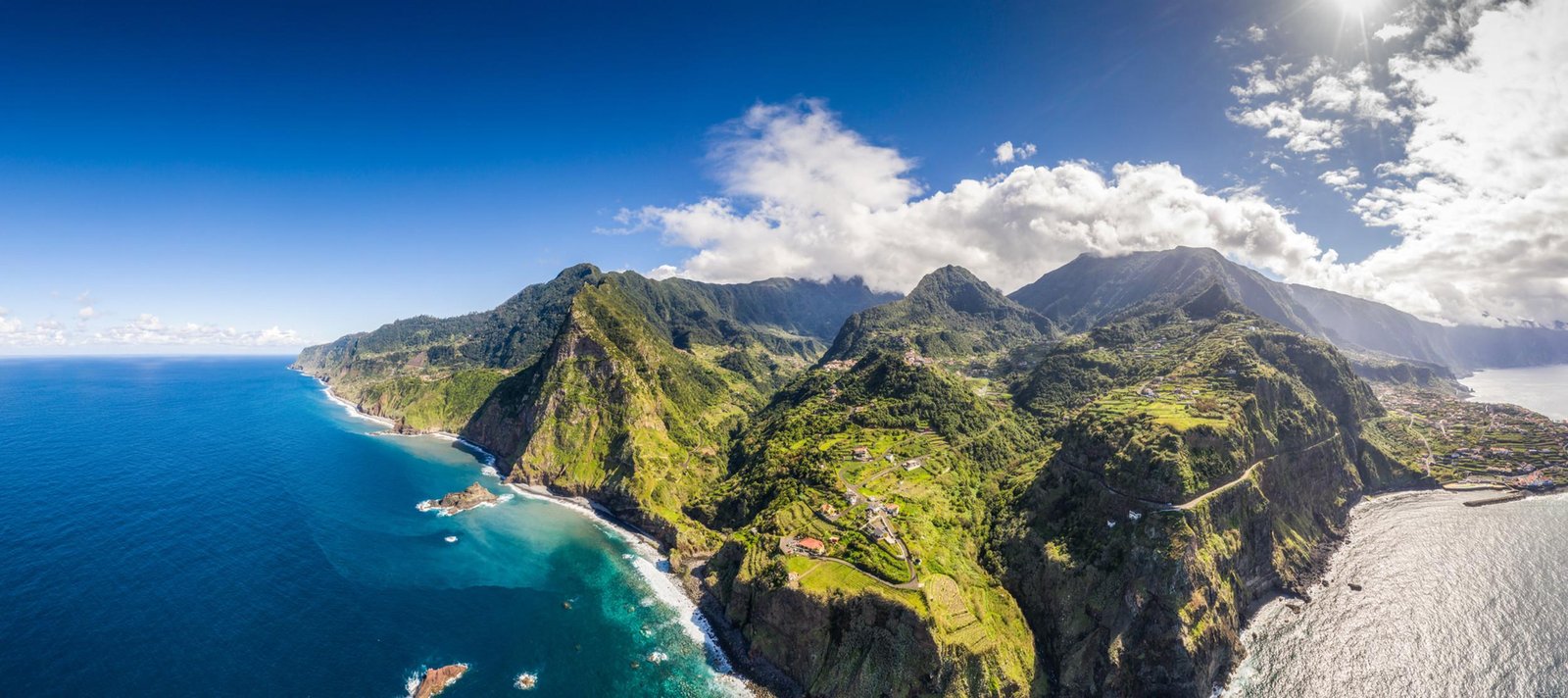
The things to do in Madeira that define a first trip are hiking the levadas and the PR1 ridge from Pico do Arieiro to Pico Ruivo, catching sunrise and sunset from high viewpoints, swimming in the natural pool complex at Porto Moniz, and riding a wicker basket toboggan down from Monte.
Food sits right beside the landscape. A glass of poncha and a plate of black scabbardfish in Funchal, the capital, tell you more about this Portuguese island than any brochure. The Monte Palace Tropical Garden then shows how much grows here once the slopes ease off for a moment.
What people tend to underestimate is the weather. The coast stays mild year-round and can feel like spring in February, with temperatures above 20 °C, while the mountains an hour inland behave like a different country.
That split shapes everything below: which accommodation makes sense as a base, how early you set the alarm, and whether a morning of waterfalls or a slow afternoon by the sea fits the day the island actually gives you.
Hiking Madeira’s Mountain Trails Without Getting Caught Out
Hiking in Madeira rewards preparation more than fitness, because the high trails often start in conditions that look nothing like the coast you left an hour earlier.
Madeira draws outdoor enthusiasts for good reason, but the rugged interior can turn misty within minutes. The Pico do Arieiro trailhead shows the gap clearly: a PR1 start has been logged at 7 °C while the shoreline sat warm, and the summit is often cold and windy at dawn.

My rule of thumb for any high-altitude sunrise is a short checklist, done in this order:
- Webcam check: view the live feed for Miradouro do Juncal the night before, since cloud decides whether the drive makes sense.
- Warm clothes packed: 0 °C with partly frozen ground has been recorded at that lookout before sunrise.
- Waterproof shoes on, then arrive about half an hour before sunrise to secure parking.
- Refillable bottle filled at your accommodation, because the PR1 can begin straight after first light.
Bica da Cana is the gentler option I’d point a first-timer toward. It sits at 1600 m, only a 10-minute walk from parking, and has been above the clouds at sunset as well as at dawn.

On the ridge to Pico Ruivo, about half of a sunrise attempt on that summit happens in the dark, which is why I lean toward daylight starts or local guides, the same logic I’d apply to canyoning. Vegan snacks turn up even at street food stalls near trailheads.
Madeira’s Viewpoints, Scenic Ridges and Coastal Lookouts
Madeira’s viewpoints fall into three groups: high mountain lookouts you can drive to, cliff paths along the coast, and garden terraces above Funchal.
The mountain group starts at Pico do Arieiro, which sits at 1810 m and can be reached by car. The ridge nicknamed the Stairway to Heaven begins there, though since the 2024 wildfires reached Pico Ruivo, only the first 1.2 km has been accessible. Even that short stretch gives a full sense of the drop.

For a view with no hiking at all, Eira do Serrado stands about 1000 meters above sea level and looks straight down on Curral das Freiras, the village in the Valley of the Nuns roughly 600 meters below. I’d put this lookout first for anyone uneasy on exposed ridges, since the drama comes without the edge.

The coast offers a different kind of height. Vereda do Larano is a cliff path for clear days, and the eastern peninsula trail ends at Miradouro Ponta do Furado, where volcanic rock meets the ocean edge, a reminder that the whole island began as cooling lava.

Along the southwest shore, sheltered coves sit beside a rocky beach with cliff views, one cove protected by a retaining wall. Closer to town, the Madeira Botanical Garden, reached by gondola, gives ocean views from its café, and guided rock climbing opens up rock faces you’d otherwise only see from the road.
Swimming in Madeira: Natural Pools, Waterfalls and Beaches
Swimming in Madeira mostly happens in natural pools, waterfall basins and small coves rather than on long sandy beaches.
That surprises people who picture a typical volcanic island holiday. Porto Moniz is the famous example, but the swim I’d tell a friend about is inland. The PR6 toward 25 Fontes descends 4.2 km through bay laurel forest to the Risco Waterfall and the Dona Beja Pool, where a pool beneath the falls allows swimming.

The climb back is the catch on that trail, and a shuttle covers part of the uphill return. Sea and air temperatures follow the calendar: August sits around 26 Celsius (79 Fahrenheit), and July and August form the high season, so pools and coves fill fast.

Ocean lovers have more than swimming to choose from. Snorkeling, scuba diving, jet skiing and dolphin and whale watching are all on offer around the island.
The water quality story is a good one too. Since 2023, 26 beaches and marinas have held the Blue Flag, and packing reef-safe sunscreen is a small habit that protects the reefs and pools you’ll swim in.
Visiting Funchal’s Tropical and Botanical Gardens
Funchal’s two headline gardens, the Monte Palace Tropical Garden and the Madeira Botanical Garden, sit on the hills above the city and are easiest to reach by cable car or gondola rather than by driving.

The Funchal Cable Car leaves from the old town and climbs about 1,800 ft to Monte in a 15-minute ride. For nature lovers the ride is half the point, with terraces of flowers, banana plants and red roofs sliding underneath while the harbour shrinks behind you.

Driving up is possible, but I see little reason to. The approach involves steep streets and narrow roads, and the traffic and parking problems of peak summer are known to be exhausting for locals as well as visitors. Arriving at opening time usually means quieter paths, too.
The return trip is its own attraction. From Monte Church, a wicker sled carrying up to three people runs about 2 km downhill at speeds up to 24 mph, operating Monday to Saturday from 9 am to 6 pm.
Towns and Villages to Explore Beyond Funchal
Madeira’s smaller towns and villages work best as slow bases for walks, cafés and coastline rather than as sights to tick off.
Curral das Freiras is the clearest inland example, a village set apart from the coastal crowds where the whole point is to slow down. Many digital nomads have settled on the island for the same reason, and if you want to base yourself somewhere calmer, the north has sustainable cafés and coffee farms.
On the coast, Calhau da Lapa shows how isolated some settlements were: a pebble beach with old cave houses, reached by a few hundred steep steps or by boat from Ribeira Brava.
Along the northern and western edges, lookouts such as Achadas da Cruz, Ponta do Tristão and Veu da Noiva reward short stops. The Levada do Moinho adds a fairly flat walk with valley views, small waterfalls and a loop through tunnels.

Village café culture is where I’d spend the spare hours. An espresso with a pastel de nata, a slice of honey cake, a cold lager, a glass of vinho verde or a jug of sangria covers most menus, and a food walking tour early in a trip teaches the names quickly. English is widely spoken, but in small places, ask permission before photographing people.
What Should You Eat and Drink in Madeira?
Madeira’s food centres on fresh fish, tropical fruit and poncha, with black scabbardfish and banana as the island’s signature plate.

The fish story starts offshore. The ocean floor drops away steeply a couple of miles out, which is why sport fishing boats chase marlin, swordfish and tuna here, and why seafood dominates so many menus.
For foodies, Câmara de Lobos shows it at source: an old fishing town of colorful boats around a small port, backed by terraced plantations climbing the slopes.

In Funchal, the market hall is stacked with tropical fruits, and Rua de Santa Maria lines up bars and restaurants along one narrow street. A walk on the seaside promenade at dusk can end at a bar with live music and passion fruit margaritas.

Two small habits help. If you want to eat less meat while here, the fish-heavy menus make it easy. A few phrases go a long way at the counter: Bom dia to greet, and Obrigada or Obrigado to say thank you, depending on whether the speaker is female or male.
Riding the Monte Toboggan and Cable Car
The Monte toboggan and cable car work well as one half-day loop: ride the cable car up, spend the morning in the Monte Palace Tropical Garden, then slide back toward Funchal in a wicker basket.
The garden is why the loop runs longer than planned. The 17-acre grounds deserve about 3 hours, mixing plants from every continent with Oriental Gardens, panels of tile art, African sculptures, a koi pond, flamingos and peacocks.

Indoors, a three-story art museum and a mineral museum sit within the grounds, which makes the garden a reasonable plan on a drizzly morning.
I’d eat before the ride rather than after. A warm bolo do caco, the sweet potato flatbread spread with garlic herb butter, is a local specialty, and a small glass of ginjinha, the sweet sour cherry liqueur, makes a fitting toast at the bottom.

Back at sea level, football fans can continue to the CR7 Museum near the port, opened in 2013 and dedicated to Cristiano Ronaldo, with over 100 trophies on display.
Museums and Historic Sites That Explain the Island
Madeira’s history shows up most clearly in its working landmarks, the levadas, the thatched houses of the north and the Monte sleds, with the island’s museums filling in the details.
For history fans, the levadas come first. These irrigation channels date back to the 15th century, built to carry water from the wet mountains to the dry south, and the network now runs over 3100 km on an island only about 55 km long.

In Santana, the triangular houses known as palheiros keep their bright paint and thatched roofs, though many now hold shops and souvenirs rather than families.
The toboggan has a past as well. The carreiros do Monte began in the 1800s as everyday transportation down to Funchal, long before anyone thought of it as a ride.
Madeira wine is history in a glass: fortified with brandy and then aged, it is easiest to understand through wine tastings at the old lodges in Funchal and Câmara de Lobos. Among the quieter things to do in Madeira, a free walking tour of Funchal ties these threads together.
When Is the Best Time to Visit Madeira?
The best time to visit Madeira for most travellers is outside July and August, with spring and even February offering mild coastal weather, fewer crowds and lower prices.

Often overshadowed by the Azores, Madeira sits off northwestern Africa, closer to Morocco than to Portugal’s capital. Its microclimates mean the forecast for one valley says little about the next.
Peak months bring the expected problems: crowded pools and busy lookouts. The Miradouro dos Balcões, at the end of the short PR11 (a flat 25-minute walk), draws steady groups of cruise tourists. Winter has its own catch, as high waves can close the Porto Moniz pools.

Sun-seekers should look at the south coast. Ponta do Sol is considered the island’s sunniest place, and its pier frames the village and beach. The eastern PR8, the Vereda da Ponta de São Lourenço, also has good sunshine odds.
For a rainy hour, the Madeira Story Centre covers the island’s past, and the yellow Fortress of São Tiago from the 1600s sits beside the old town. Slower, off-peak trips also leave time for walks with the Ponta do Sol dog shelter on Tuesdays, Thursdays, and Sundays; supporting stray animal shelters is a simple way to give back, but contact them first.
Choosing Where to Stay on the Island
Where you stay in Madeira matters less than most travellers expect, because most of the island sits within one hour of anywhere by car, so the choice comes down to sunshine, convenience or quiet.
Funchal suits travellers without a rental car, with sights like the Museu Militar da Madeira, covering 300 years of weapons and fortress history, right in town. East of the city, Canico is handy for Madeira Airport, and the cliffs at Ponta da Cruz hold resort hotels about ten minutes from downtown.

Madeira has few all-inclusive resorts. Choosing locally owned accommodation keeps more money on the island, and some hotels carry Green Key certification.
Sunset lovers lean west-facing: Calheta, Paul do Mar and Ponta do Pargo all watch the sun drop into the sea. The north is quieter, with São Vicente feeling like a hidden gem below the Capela de Nossa Senhora de Fátima viewpoint, wineries in the area, and Seixal adding a black sand beach.
Prices swing by season, with accommodation in July and August running about three times May rates. If driving isn’t for you, 4×4 jeep or buggy tours, from a few hours to a full day, include pickups in Funchal and Caniço.
How Do You Get Around Madeira?
Getting around Madeira is easiest by rental car, because the island is small but its trailheads, gardens and villages are spread across steep terrain.
The island measures roughly 35 miles long and 14 miles wide, yet its mountainous roads run through more than 150 tunnels, so distances that look short on a map take longer at the wheel. A car keeps day trips simple, and many places offer free parking; staying near the airport suits early flights.

Car rental also unlocks spots that are awkward otherwise, such as the Roseiral Quinta do Arco, a rose garden with over 1,500 species named a Garden of Excellence by the World Federation of Rose Societies.
On the way west, the Cabo Girão skywalk puts a glass-bottom platform about 580 meters above the sea on what is described as the highest cape in Europe.
Some places reward leaving the car behind. Jardim do Mar is a village of cobblestone alleys where cars are largely absent. The Madeira Island Ultra-Trail crosses the island for 115 km from Porto Moniz to Machico over about 4–6 days; I haven’t attempted it myself, but it is slow travel in its purest form, and packing light becomes essential.
Adventurous Things to Do in Madeira on Water and Land
Adventurous things to do in Madeira include canyoning, rock climbing, sport fishing and whale watching, and the land-based ones are normally run with local guides.
For adventurers drawn to the sea, the Atlantic is the main event. Before heading out on a boat, I’d spend an hour at the Museu da Baleia da Madeira in Caniçal, where life-size whale and dolphin models explain the island’s whaling history, which ended in the early ’80s.

That context changes how you pick a tour. Look for operators that put animal welfare first, skip aquariums, and avoid anything edging toward animal cruelty; the island’s silver seal from EarthCheck reflects a wider push in that direction.
Land adventures come with logistics. Drives typically take 45 minutes or more on mountain roads, villages have narrow alleys, and driving isn’t recommended for inexperienced drivers. Even the airport is a 20-minute drive from Funchal.
After a day of canyoning, the PR18, Levada do Rei, is the recovery walk I’d choose: a mostly flat 8 km round trip past waterfalls that suits sore muscles. Finish with poncha, made from sugarcane rum, honey and lemon, or grilled lobster by the harbour.
Travelling Madeira Responsibly
Travelling Madeira responsibly means spending with local businesses, cutting plastic and water waste, and treating religious and residential spaces with respect.
Getting here is the biggest footprint. Madeira is reachable only by air, since the ferry to mainland Portugal no longer runs, with flights from Lisbon and other European destinations. Staying longer and moving less on the island softens that impact.
Day to day, a few habits make a real difference:
- Water filter bottle: levada hikes are long, and a filter removes the need for bottled water.
- Markets: the organic market in Ponta do Sol on Saturday mornings and the Mercado dos Lavradores in Funchal keep spending local, and nearby menus feature limpets, octopus, sardines and mussels.
- Rum tastings: poncha bars and small producers keep money with island owners.
- Eco hotels: these cluster in the remote north, alongside sustainable cafés and coffee farms.
Respect matters at religious sites too. The Convent of Santa Clara in Funchal dates to the 1400s, and its tiled interior is still home to Franciscan nuns who run a school and kindergarten, so expect limited hours and keep voices low.
Paying in the Euro feels familiar to anyone from mainland Europe, which keeps budgeting simple.
Language, Currency and Attraction Costs
Madeira uses the Euro and Portuguese is the local language, and most paid sights charge a modest per-person entry fee that is easy to check before you go.
Menus are where language matters most. Ordering Espada com banana frita gets you black scabbardfish with fried banana, sometimes with passionfruit sauce, and many locals switch to English if you stumble. Most hikes now charge a fee too, payable in person or online through a QR code.
Accommodation is where costs really diverge. Resort stays bundle infinity pools, fine dining, yoga, tennis, golf, massages and saunas into one spa rate, while guesthouses keep things simple; neither is better, they simply suit different trips.
Typical adult prices for the paid sights mentioned in this guide look like this:
| Attraction | Adult price | Useful note |
| Cabo Girão skywalk | From €2 | Children under 12 enter free |
| Porto Moniz paid pool | 3 euros | A free natural pool sits nearby |
| Monte Palace Tropical Garden | Around €12.50 | Allow about 3 hours |
| Cable car from the old town | €18 return | Climbs to Monte |
| Monte wicker basket ride | €27.50 for one, €35 for two | Runs Monday to Saturday |
| CR7 Museum | About €5 | Near the port in Funchal |
Things to Do in Madeira With Kids
Madeira is more family-friendly than its hiking reputation suggests, with short forest walks, natural pools, playgrounds and calm beaches that suit young children.
Fanal Forest works at a toddler’s pace. It is part of the Laurisilva UNESCO World Heritage site, where trees are mostly over 600 years old and the woodland is believed to be 90% primary forest. The PR 13 passes through, but a short wander is plenty for toddlers, and it runs much colder than the coast.

For swimming, the paid Piscinas Naturais do Aquário at Porto Moniz has a children’s pool and a playground beside a main swimming area of 3,800 m² whose deepest point is about two meters.
Beaches are a mixed bag. Madeira lacks white sand, but Praia Formosa mixes pebbles, sand and play areas, and Machico has golden sand and calm water.
Funchal’s Parque Santa Catarina has one of the larger play areas, and a waterfront hotel with indoor pools gives a backup when brief showers roll in, as they can in late April, when days sit around 19 Celsius. Some resorts link to town by a coastal promenade that passes through a sea tunnel.
Trip length matters more with children: two weeks is comfortable, ten days works well, and one week is the absolute minimum.