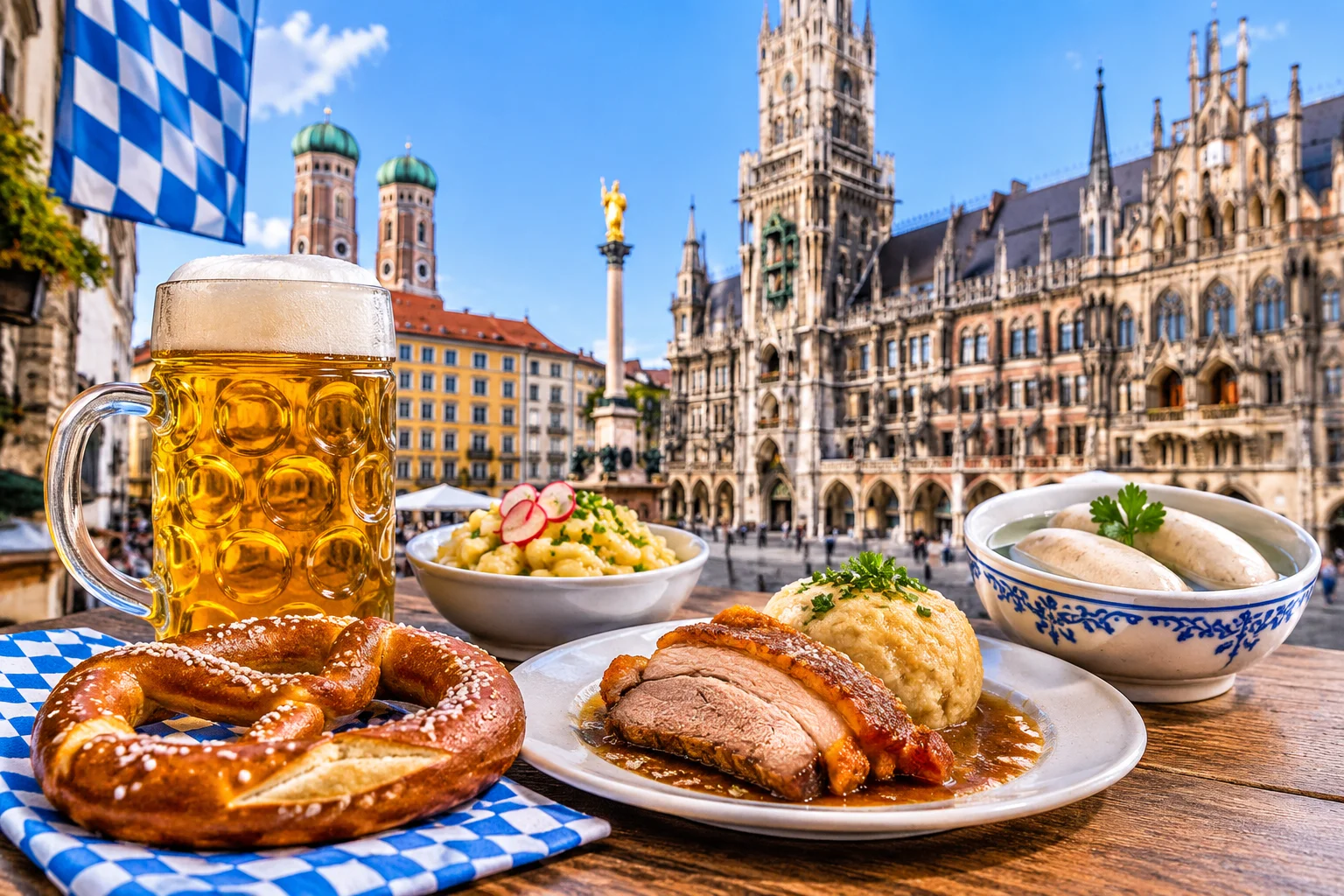
The best food in Munich Germany mixes Bavarian staples such as white sausage, a pretzel and a glass of Weissbier with a restaurant scene that reaches well beyond schnitzel.
I have not personally eaten at every place mentioned here, so this guide shares general knowledge about the city, the way a friend would. A beer hall like the Hofbräuhaus and a table in a biergarten are the obvious starting points, while the Viktualienmarkt and dining rooms such as Theresa and Weinhaus Neuner show a quieter side.
Some visitors call Munich Italy’s northernmost city, and the Italian influence on menus is easy to spot. Breakfast might be a bagel with goat cream cheese and apricot jam, and even Munich Airport deserves a look, with 60 restaurants and cafés, among them the ski-themed SportsAlm, where a cable car holds a cosy table for two.
Which Bavarian Classics Count as the Best Food in Munich Germany?
Traditional Bavarian cooking in Munich centers on roast pork, dumplings and beef soup, the staples of beer hall menus.
What I find useful is ordering one Bavarian variety plate when a menu looks unfamiliar, because a single version combines a cream cheese spread, ham and cheese slices and spicy sausages. Big beers call for snacks, and a cheese plate with a bread basket is a modest way to line the stomach without spoiling dinner. Restaurants like Haxnbauer add some theater too, with meat turning on a spit behind the window.
On the lighter side, Obatzda is a cheese pâté seasoned with paprika, and it sits beside potato salad and sausages at the self-service counters near the Chinese Pagoda, the landmark also called the Chinesischer Turm. Even the retro Smoky Joe’s van that looks like a plane sells a Bavarian sausage, served hot dog style.
Beer Halls Where Munich Eats and Drinks Like a Local
A Munich beer hall is a large, busy and informal room where traditional Bavarian food arrives alongside the beer.

The ordering system is simple once it is written as steps:
- Choose any open seat yourself.
- Wait for the server, often wearing a dirndl or lederhosen, to reach your table.
- Place your order and receive the drinks.
- Pay straight away, usually in cash, though cards are often accepted.
Beer choice shapes the meal. Dunkel is the darker, more bitter style, the lighter wheat beer tastes slightly sweet, and the soft ring of bread sold in every hall comes sprinkled with salt to encourage another round.
The surrounding streets reward a short walk. An Italian-style bar at Ledererstraße 23 stands a stone’s throw from the best-known hall, and Haxengrill is listed at Sparkassenstraße 6. For open-air drinking, the Königlicher Hirschgarten is described as the largest beer garden in the world, and the second largest in the city is the Chinese Tower. Augustiner Keller and Löwenbräukeller are two more names to look up, while a pfand, or deposit, on bottled drinks is returned along with the bottle token that proves where it was paid.
Where to Order Pork Knuckle in Munich
Pork knuckle is served at Augustiner Bräustuben, a brewpub with traditional beer-hall food, and it arrives with crispy skin.

The roasting restaurant a short walk from the address Platzl 9 is known for the same dish, so comparing two versions in one afternoon is realistic. This is hearty food, and I would plan the rest of the day around it.
Not every Bavarian meal revolves around a knuckle. A neighborhood inn such as Wirtshaus Eder at Gollierstraße 83 offers a broader menu in a residential area, while wood-grilled meats and a hanger steak show the grill side of the city. The LOUIS Grillroom features steak from different countries, with grain-fed Nebraska beef presented as its top steak.
Beer Gardens Worth a Detour When the Weather Allows
A Munich beer garden is an open-air terrace serving traditional food and beer, and many sit beside a market or inside a park.

Drinks run from a stein holding a liter of beer to a lighter Helles Radler, which blends beer with lemonade, or a Hefeweizen. Plan for communal seating, which is standard in the beer halls. Plates of sauerkraut and sausages are the traditional pairing, while Tambosi, a terrace restaurant near Odeonsplatz, offers Italian-inspired pizza and salads for people who want a garden mood without heavy sausages.
At the beer garden beside the food market, visitors may eat what they bought at the stalls, provided a drink is ordered, and a maypole marks the market’s center. Smaller options exist too: Fräulein Grüneis is a tiny kiosk-style café with mostly standing tables, and Die Goldene Bar, behind Haus der Kunst, has a terrace overlooking the city’s biggest park. At the airport, Airbrau adds a beer garden to the only brewery inside an airport.
Where to Browse and Snack in Munich’s Open-Air Market
Sausage is the quickest snack at Munich’s central open-air market, served hot dog style in a fresh white roll with mustard.

The table below compares the two sausages a visitor sees most often.
| Sausage | Main meat | Serving style | Tradition |
|---|---|---|---|
| Bratwurst | Finely minced pork or veal | Grilled over charcoal | Found throughout Germany |
| Weisswurst | Finely minced veal with spices | Munich’s local variation | Made fresh each day without preservatives before refrigeration, so eaten as a morning snack |
Next to the market, a beer garden sits under shady chestnut trees. A picnic is another option in the Hofgarten, once the private space of the Wittelsbach rulers and now a public park where people play boules.
One central breakfast spread I have read about includes artisan cheeses, nuts and seeds, muesli and fresh orange juice, which also gives picnic ideas. Travelers who miss the market can still pick up regional specialties in the café beside the Bayern Lounge at the airport.
How Much Italian Influence Is on Munich’s Plates?
Italian influence is visible across Munich, the capital of Bavaria, where a cosmopolitan mix of German and Italian cooking appears on many menus. That blend is one reason the best food in Munich Germany is hard to pin to a single cuisine.

Brenner takes its name from the German for charcoal burner and is set in 300 year old royal stables, while the Brenner Grill, a large bar and brasserie, is listed at Maximilianstraße 15. Aperitifs follow the same path: the Aperol spritz migrated from northern Italy, the Aperol sour is a popular local alternative, and a Negroni also appears on bar menus alongside small plates.
German cooking holds its own, since spinach and cheese spaetzle can arrive with a side salad dressed in Honig-senf, a German-style honey mustard. Sweet endings range from spaghettieis, or spaghetti ice cream, to artisan ice cream and crêpes. A short walk from Marienplatz, the city’s largest market has stood on its present site since 1807, after outgrowing the square.
Steakhouses and Bistros for a Proper Dinner
Dinner on a Saturday night is easier to plan with a reservation, and Munich offers sophisticated options well beyond the beer halls.
Bar Buffet Kull is described as Munich’s answer to a French bistro, with red checked table cloths and plainly prepared dishes such as wild salmon, plus a signature tuna starter. Grilled salmon and venison appear on other Bavarian menus, and at the airport brewery the trout arrives with parsley potatoes.
A grill that describes itself as the place where Milan meets Munich also serves fresh pasta, which shows how far the Italian mix reaches. Some restaurants lean toward meat eaters, so vegetarians should check the menu first, although at least one grill lists good veggie options. Cocktails at Schumann’s Bar, a New York-style bar listed among the Top 50 Bars in the world, are an option before dinner.
Best Food in Munich Germany Beyond the Beer Halls
Beyond the beer halls, Munich’s cooking includes seasonal menus, northern Italian dining rooms and brunch cafés.

Anyone searching for the best food in Munich Germany should watch the calendar, because asparagus, artichokes and radishes appear in season during spring, and restaurants build dishes around them. Ornella serves that Italian style in a dining room, and a short blackboard menu at a small Italian bar can list seafood linguine.
Rich plates matter too. A grill kitchen may serve a steak in demi-glace beside pureed cauliflower with truffles. For something lighter, Kochspielhaus, running since 1980, offers shakshuka and avocado toast, while Turkish eggs appear on a hotel breakfast table. Tradition still has a place: Schneider Bräuhaus, open since the 1870s, stayed open on Boxing Day, when nearly everything else was closed, and a small oompah band adds to the mood.
Where to Have Breakfast or Brunch in Munich
A sit-down breakfast in Munich is easy to find, from the back room of an Italian coffee bar to a hotel wine bar that doubles as a breakfast room.

Bar Centrale is the coffee bar in question, where a La Marzocco machine steams milk and the back room serves a sit-down meal, though the room can be full without a booking. Grapes Weinbar works as a hotel breakfast room in the morning, then becomes an all-day café and wine bar with light dishes such as smoked trout, terrines and sorbets.
Foodies on a weekend trip will notice that seasonal produce shapes the menus, with berries in summer and mushrooms in autumn. Cheesecake with apple compote is on a neighborhood inn’s menu for something sweeter. At the airport, the Cloud 7 café sits on an observation deck with a retro plane theme and an emphasis on lighter food.
Wine Bars, Lakeside Drinks and Brewery Visits
Wine drinking in Munich has deep roots, since the city’s oldest wine bar has operated for over a hundred years inside a three hundred year old townhouse.
The decor there is described as clean and crisp, much like a Riesling. Some restaurants season tartare at the table from jars of toppings, among them capers, egg yolk, Tabasco and Worcestershire. Beer follows the seasons as well, and in September an Oktoberfest beer joins the usual list.
Away from the bars, the Englischer Garten holds the Seehaus beside the Kleinhesseloher lake, where visitors can hire a rowing boat or a pedalo. Cafés pour drinks too: Vits Kaffee at Rumfordstraße 49 offers lunch or a beer in the afternoons, and the airport brewery shows off its copper vats and runs a brewery tour most days.
Eating Well Before a Flight Out of Munich
Eating well before a flight out of Munich is realistic, since the airport has its own brewery, cafés and restaurants.
A short break leaves little time, so early planning helps: a pretzel croissant sandwich can sell out within an hour of opening, and scrambled eggs with bacon are the plainer alternative. Airport cafés also cover lighter, healthy food, and the beer has history behind it, since Paulaner am Nockherberg has brewed at its site since 1634 and takes its name from the monks who lived there.
Local craft beer from Hopfenhäcker is another way to taste the city, and the brewery tour runs most days except Sunday. Weather and holidays change plans: on a rainy day beer gardens may close, and around Christmas many places shut. If time remains, the cocktail bar behind the art museum has golden wall maps from 1937 that show where spirits and tobacco came from.