
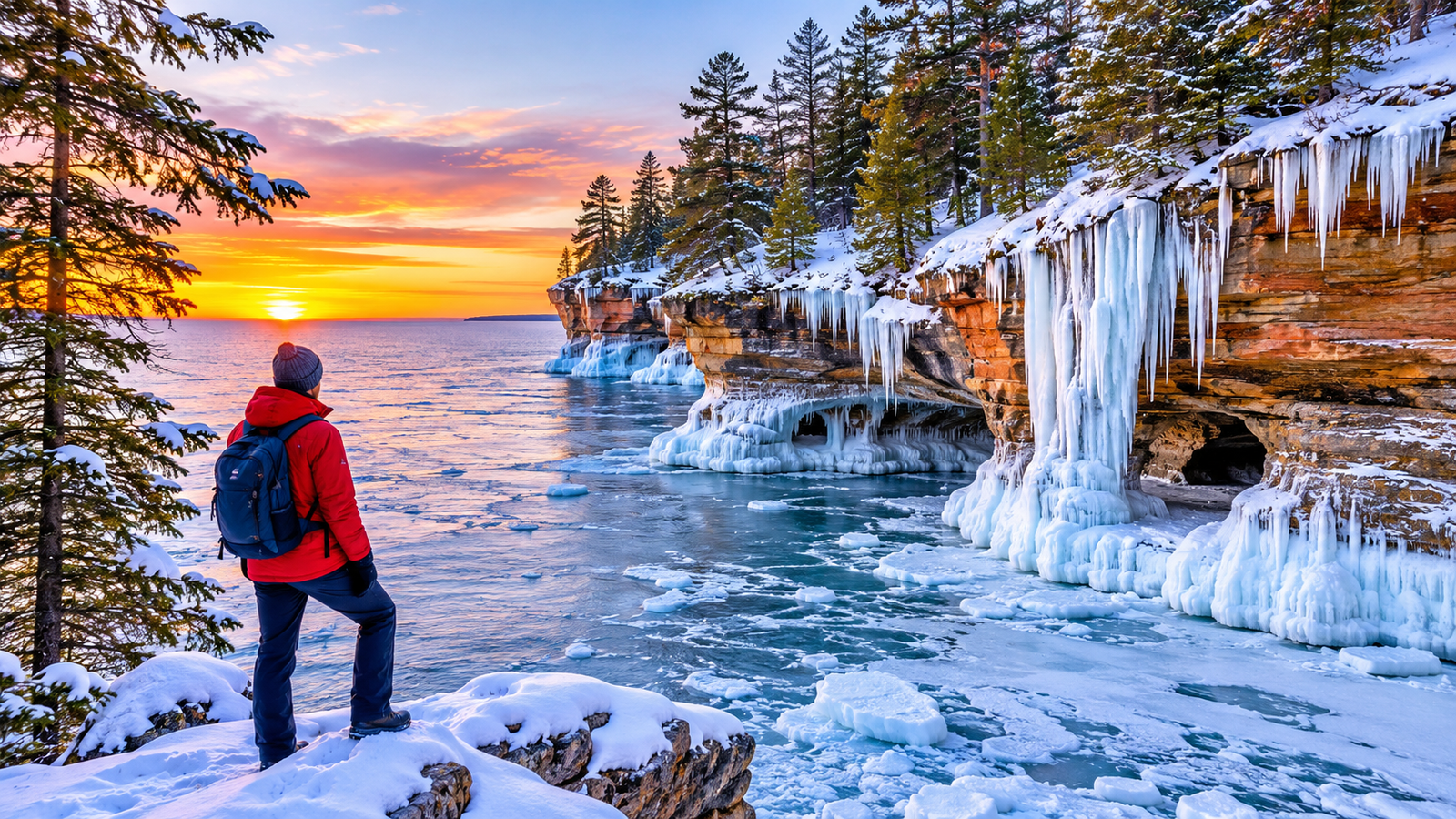
An Apostle Islands winter runs through December, January and February, a season when the Bayfield peninsula sits blanketed in snow under subzero temperatures, and the famous ice caves near Meyers Beach can be walked to only very rarely.
The numbers explain why. According to the National Park Service, the mainland caves were accessible on just 2 percent of all days from 2000 to 2023, so most winter trips here are really built around everything else the shoreline offers.
That “everything else” is substantial: snowshoeing along the shore, ice fishing, a warm base in town, and a trip to Madeline Island, the only island that stays open through the season. Check cave status the week you travel, because a page that reads closed in autumn tells you nothing certain about February.
How Cold Is an Apostle Islands Winter?
The Apostle Islands get cold enough that the shoreline feels shockingly cold even to people raised in Wisconsin, mostly because of extreme wind coming off Lake Superior.
 Damp air matters as much as the temperature reading. Lake moisture makes the cold feel sharper, and the snow it produces piles up quickly across the mainland, which is where nearly all winter activity happens now that every island but one is shut for the season.
Visitors who are not acclimated to northern winters should study temperature trends for their intended dates before booking, since the same week can swing from tolerable to brutal. The National Lakeshore itself stays open for hiking, and the Bayfield area keeps its restaurants and lodging running.
When Is the Best Time to Visit the Apostle Islands in Winter?
February is generally the best month for a winter vacation destination trip here, because lake ice is most consistently thick then, but it is also the month when the ice caves draw the largest crowds.
Trail conditions follow the same calendar. Good snow cover for snowshoe and cross country skiing outings usually arrives in January and February, so visitors who skip the cave crowds can still schedule around the snow instead of the ice.
Timing also shapes where you sleep. Winter is the off season in Bayfield, which helps rates, and the choices are distinctive: Boulder Ridge Treehouse for a romantic getaway, the Lake Superior Barn for a group, the Bayfield Rustic Yurt for something simple, plus Canoe Bay Escape Village and Camp Lake Resort for cabin-style stays. Tickets or access fees only matter in the rare years the ice lets the caves open.
What Are the Lake Superior Ice Caves?
The Lake Superior ice caves are winter sculptures of ice that form along the cliffs and sea caves near Meyers Beach, where waves and water seeping between sandstone layers freeze into sculptures.
Color is part of the draw. Cliffs of rust-colored stone form crimson red borders around the white, and water running off the cliffs hardens into icicle formations that eventually close into cave-like pockets at the base.
As the big lake freezes over, the ice builds into sheets, stacks and icicles, and the force of the water pushes it ashore in mounds. The shapes change from one cave to the next and from one day to the next, which is why no two visits look alike.
Why Access to the Apostle Islands Ice Caves Is Rare
Access to the ice caves is rare because the ice must pass a long checklist before anyone may walk out, which works out to roughly one day in fifty.
Rangers need sustained low winds so an unbroken ice shelf can form, and that shelf has to be anchored to 3 land points and reach miles out from shore so it can withstand lake currents.
The ice must also bond to frozen ground onshore, show enough thickness to carry people and emergency vehicles, and pass auger tests confirming its stability and quality. Missing any single item keeps the caves closed, so the practical advice is to treat cave access as a bonus on top of a trip that works without it.
Conditions That Make the Ice Caves Safe to Reach
Reaching the caves safely takes calm air, long deep cold, a shelf of ice locked to the shoreline and ice thick enough to carry people, and the whole arrangement fails once open lake conditions return.
The largest lake in the world gives ice little protection. Wind and waves can break up apparently stable cover within hours, and wind chills make a bad situation worse for anyone caught out on it. That is why visitor safety sets the pace for every decision.
A 2013 example shows how fast it can turn. On February 6, 2013, the park was ready to announce that the caves would open. By 8 a.m. the next day the shelf had started to break apart, and by the morning of February 8 the area was open water. The park’s webcam comparison was captioned as showing a breakup in under 12 hours, and walking out in hazardous conditions like these is exactly what the checklist exists to prevent.
Why Lake Ice Is Hard to Plan Around
Lake ice here is unpredictable: park staff open the way only when safe access exists, and that has happened in only a handful of seasons.
| Year(s) | What the park record shows |
| 2004, 2008, 2009, 2014 | Most ice cave events since 2000 fell in these four years |
| 2015 | A brief nine-day period of access |
| 2026 | Access for one day in 2026, per the park’s statement |
Counting open days instead of events makes the point sharper: the caves were closed on nearly every day of the period. Because conditions stay unfavorable most winters, ongoing monitoring continues even when nothing is announced.
How Can You Tell Whether the Ice Caves Are Open?
The most reliable way to learn whether the caves are open is to follow the park’s official channels rather than the webcam, because a camera view can be misleading when ice looks solid but has no protection beyond the cliff base.
Winter 2026 showed the problem. Webcam frames from 4:00 p.m. on February 17 and the morning of February 18 captured a dramatic change, with the ice around the caves gone.
Satellite imagery tells the longer story. MODIS satellite pictures from NOAA CoastWatch, comparing March 2014 with March 2024, show how different the lake can look from one winter to the next.
Finally, Park Service rules do not allow anyone to charge a fee for tours of the caves inside the National Lakeshore, so a paid cave-tour offer deserves skepticism.
What to See Along the Frozen Shore
Along the frozen shore the main sights are the ice formations themselves: pillars of ice reaching up cliff faces, hardened waterfalls, and shelves hugging the base of the red cliffs.
Inside a cave, needle-like icicles hang through every one of the chambers, a fairyland that reshapes itself from day to day as water from runoff keeps freezing.
When the caves are out of reach, the lake still delivers a winter wonderland: white ice against blue sea. Bring a camera, since the best viewpoints along the coastal routes put the whole frozen shore in one frame, and the photographs read very differently as the light shifts.
Winter Hiking Around the Ice Caves
Winter hiking is worth it even when the caves are closed, because the cliffs, hollows and ice enclosures along the shore can be seen from solid ground.
The caves sit about 20 miles northwest of Bayfield, reached by following highway 11, and in a rare open year the walk out runs two to three miles each way. Walking the beaches in winter is its own reward.
Plan for short days and colder nights. Visiting earlier in the winter avoids some of the traffic, and most people dress in layers, beginning with a base thermal layer, and choose footwear with real traction for ice and snow.
Can You Go Ice Fishing in the Apostle Islands?
Yes, ice fishing is a long-standing winter pastime around the Apostle Islands, and anglers need the right permit and the right clothing for sitting still on open ice.
Wind is the real enemy out there, so a windproof outer shell, gloves, a scarf and a hat matter more than any piece of fishing gear. In the coldest months, temperatures can run from highs in the ’30s to lows well below zero.
Some anglers get around by snowmobile rental, which adds a thrill of speed across open terrain, though ice thickness should be confirmed before anyone drives onto it. Afterward, the neighboring town leans toward bar food, while Bayfield’s Pickled Herring is a less expensive option than the formal inns.
Snowmobiling and Skiing Near the Apostle Islands
Snowmobiling is an option along parts of the National Lakeshore, and it gives different vantages on the offshore beauty than hiking does, especially where routes cut through woodland.
The area works as a year-round outdoors destination, so a local operator can usually explain current routes, though some visitors prefer to go independently. When ice conditions allow, a temporary county road across the lake reaches Madeline Island, the sort of detail worth asking about before you go.
Other winter movement is easy to find. You can ski at Mt. Ashwabay, ride a fat tire bike around the surrounding communities, or check winter conditions at Pictured Rocks National Lakeshore in Michigan if the Wisconsin shore disappoints.
Things to Do When the Ice Caves Are Inaccessible
When the caves are inaccessible, the Lakeshore Trail still lets you see ice from the shore, and several other winter hikes can fill a day.
| Trail | Distance | Time | Difficulty |
| Red Granite Falls Trail (state park) | 2.5 miles, loop | 2 hours | Easy; moderate in snow |
| Winter Waterfall Loop (state park) | 1 mile, loop | 30 minutes | Easy |
| Lakeshore Trail, sections 1 and 2 | 4.8 miles, out and back | 3 hours | Easy; moderate in deep snow |
Most trails here are easy but turn moderate in deep snow. With the islands closed for the season, Little Sand Bay is a good place to look out over the frozen lake and spot many of the Apostle Islands.
Parking at the Meyers Beach trailhead costs $5 per vehicle. Pack crampons and trekking poles for the ice, since snowshoes are the better choice after fresh snow.
Where to Stay and Eat in Bayfield
Staying in or near Bayfield works best for a winter trip, ideally in a cozy cabin-style place with good food within easy reach.
Book early: lodging availability tightens at the busiest time, which tracks demand when the ice looks promising.
For dinner, Old Rittenhouse Inn serves a five course gourmet meal at a high price, while Pier Plaza Restaurant costs less, and Mannypenny Bistro is a hearty breakfast stop.
On day trips, Ashland is known for its murals, South Shore Brewery is a warm-up stop there, Copper Crow Distillery pairs cocktails with board games, and Bayfield’s own artsy shops fill an afternoon.
A Winter Weekend in Bayfield
A winter weekend in Bayfield splits neatly into a state-park day and a lakeshore day, and this order works well:
- Start at Copper Falls State Park, where admission is $8 per vehicle with Wisconsin plates and $11 for out-of-state cars. Walk the waterfall loop to see Brownstone Falls still running, and add the Doughboy Trail if energy allows.
- Spend the afternoon and dinner in town, then sleep at a bed and breakfast or similar stay.
- On day two, eat breakfast, drive to the Meyers Beach trailhead and hike toward the caves, stop at a distillery on the way back, and finish with a stroll through town.
Winter is the quiet season, so reduced room rates are common. An inn in town suits couples, cottages with a grill area suit families, and a remodeled barn or a yurt with a wooden stove and fire pit suits anyone who wants to unplug. Ending the day beside a fire is half the point of the trip.
What to Pack for the Apostle Islands in Winter
Pack warm clothes built for wind, because wind chill can make the air feel 20 degrees cooler than the thermometer reads.
Insulated boots and coats come first. If you forget either, shops in the area sell them, so dress accordingly and don’t let a missed item cancel the trip. Pair them with the layering and traction advice from the hiking section.
Anglers who plan to drop a line should bring a fishing license, since locals set up fish houses on the ice. The reward is a dreamy setting that earns its bucket list reputation.
FAQs
Why Are the Ice Caves Closed?
The ice caves are closed because a powerful storm wiped out the ice that had formed around them.
Even the thickest ice cannot survive when wind and waves reach a shoreline that has no protective shelf, and the sea caves along the cliffs depend on that shelf more than anything.
Weather patterns such as cold fronts and heavy snowstorms can build conditions up or tear them down, which is why a promising week can end in a single night.
Can You Use a Fee You Already Paid for the Caves?
Yes, a payment made for cave access remains valid if you could not get out to the caves.
The closure followed a strong winter weather system that removed the lake ice around the caves. If your plans depended on a cave walk, rebuild your itinerary around the other winter options in this guide and hold the payment for a later season.
Will the Mainland Ice Caves Reopen?
The mainland ice caves are unlikely to reopen in 2026, and access is closed for the foreseeable future.
Anyone who bought the NPS Ice Cave Fee but could not reach the caves will have that purchase honored for a future date.